NQ Pilot.
Discipline over
frequency.
A discretionary intraday framework for Nasdaq-100 futures — long and short. One screen, five layers, two factors that matter: find the A-grade setups, scale MNQ in and out to manage risk, then stand aside for the rest. Tuned for a 50K prop account with a $2,000 drawdown.
- Instrument
- MNQ scaled in / out
- Direction
- Long & short
- Tuned For
- 50K $2K drawdown
- Setups
- A-grade selective
// sample a-grade output
grade ······ A CLICK IT
direction ·· LONG
entry ······ 29,310 — failed-breakdown reclaim above VWAP
invalidation 29,285 (-25 pts)
first target 29,360 (+50 pts) — scale half, stop to entry
thesis ····· VIX ↓0.7%, all 4 megas green, 10:15 slot, third defense bar
watching ··· Loss of VWAP on a 15m close downgrades the setup
01 / 05·Discipline over frequency
Philosophy
Most intraday traders die from one thing: too many trades. The Nasdaq gives you a hundred reasons to click every morning. NQ Pilot rejects all of them except the ones that survive a structured filter.
The framework is built on a simple truth verified across 250 RTH sessions: from any random entry, the market reaches ±50 points within an hour about 83% of the time. The market gives the move. Direction selection is the entire game.
So we don't chase signals. We grade them. Every potential setup is scored against a regime filter, a timing filter, a trigger, and a quality booster. If it doesn't reach A-grade, we pass — even if it looks tempting.
In live trading that discipline shows up in the numbers: a typical session runs anywhere from a couple of trades to about twenty-five, concentrated in the morning window — nearly every trading day, with the rare flat session when nothing reaches A-grade.
- PRINCIPLE 01
Regime first, pattern second.
VIX direction and mega-cap breadth decide the day. Price patterns time the entry — they never define it.
- PRINCIPLE 02
One screen, five layers.
VWAP · Structure · Order Flow · Cycle · VIX. Confluence across at least three is the price of entry.
- PRINCIPLE 03
Time matters more than price.
10:00–11:30 ET is the high-edge window. After 13:30 the edge collapses for longs. The clock is a filter.
- PRINCIPLE 04
Flat by 15:45 — always.
No exceptions, no "just one more". The session ends before the close so the trader stays sharp the next morning.
- PRINCIPLE 05
Pass > force.
Skipping a B-grade setup is a winning decision, even on a day that ends flat. Forced B-grades are how accounts bleed.
02 / 05·The screen I trade from
The Stack.
One workspace, one instrument, five layers reading the same tape. VWAP, SVP HD, ORB, Camarilla pivots, LuxAlgo Order Flow, Cycle oscillator, TICKQ, VIX, Cumulative Tick — all on a 15-minute NQ1! chart.
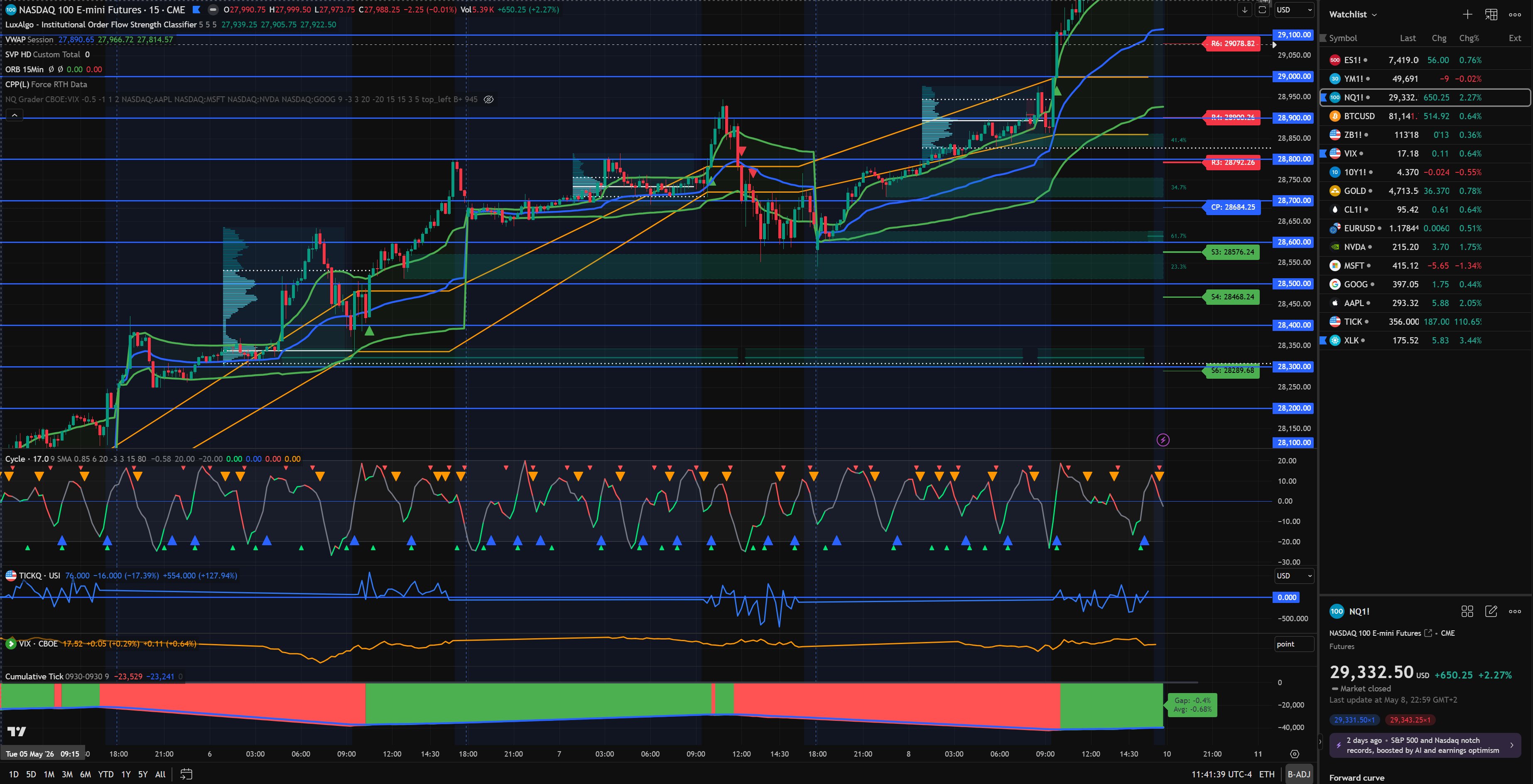
VWAP
Session-anchored from 09:30 ET. Defines whether the day is bid (above) or offered (below). Defense at VWAP across consecutive 15m bars is the cleanest long trigger.
Structure
SVP HD overnight profile (VAH/VAL/POC), 15-min ORB, Camarilla pivots (R4/R3/CP/S3/S4), and live options-gamma levels — the flip line and the call and put walls where dealer hedging cushions or accelerates price, refreshed throughout the session. The map of where buyers and sellers have already shown up.
Order Flow
LuxAlgo Institutional Order Flow Strength Classifier plus Fair Value Gaps. Confirms whether real money is on the same side as the regime.
Cycle
9-SMA cycle oscillator. Cross Below print is the strongest discrete short trigger in the dataset (59% WR with VIX↑2%). Extreme readings veto continuation.
VIX
The single most useful number on the screen. Falling ≥0.5% favors longs; rising ≥1% favors shorts. Combined with mega-cap breadth, it sets the entire day's bias.
03 / 05·How a setup earns a grade
The Rubric.
Every potential trade is scored against a four-factor rubric: regime (VIX + mega-caps), slot (time of day), trigger (the price-structure event), and cycle (continuation booster or veto). Grades are ordinal — only A reaches the click.
Click It
Regime confirms · high-edge slot · clean trigger · cycle not in veto zone. The only grade that earns size.
Watch It
Regime present but missing one filter. Worth tracking; not worth taking. Useful for marking out levels.
Note It
Trigger fired but no regime tailwind. The kind of setup that produces "almost worked" charts after the fact.
Pass
Counter-regime, dead-zone slot, or cycle veto. Hands off the keyboard. Move on.
grade        A  CLICK IT
direction    LONG
entry        29,310  // failed-breakdown reclaim above VWAP
invalidation 29,285  // −25 pts
first target 29,360  // +50 pts → scale half, stop to entry
thesis       VIX ↓0.7% · all 4 megas green · 10:15 slot · third defense bar
watching     Loss of VWAP on a 15m close downgrades the setup
04 / 05·A day in the chair
Session Flow.
From bell to flat. Five checkpoints that anchor a discretionary day with the rhythm of a system.
- PRE-OPEN
Read the regime.
VIX direction. Mega-cap pre-market. Overnight profile. Calendar. Form the bias before the bell.
- 09:30 — 09:45
Mark the ORB.
First 15-min range becomes the day's reference. No new entries inside it unless a complete trigger fires.
- 10:00 — 11:30
Hunt the A-grade.
The institutional rebalance window. Highest-edge slots in the dataset. If the setup arrives, it usually arrives here.
- 11:30 — 14:00
Manage or stand aside.
Manage the morning trade or hands off the mouse. Lunch chop favors no one but disciplined shorts in VIX↑ tape.
- 15:45 ET
Flat. Done.
FlatGuard rule. No exceptions. The day's score is logged; the rubric gets the post-mortem; tomorrow gets a fresh chart.
05 / 05·What NQ Pilot is not
Boundaries.
Clarity about what this is — and isn't — protects the user from misusing it.
It is not an algorithm.
Every trade is clicked manually. The framework grades; the human pulls the trigger.
It is not a signal service.
No alerts, no calls, no copy-trading. It's a decision-support rubric for the trader using it.
It is not high-frequency.
One to a few A-grade setups a day, nearly every trading day — scaled in and out with MNQ to manage risk. Consistency, not volume, is the point.
It is not a get-rich plan.
It's a discipline framework with a measured edge. Compounding comes from execution, not from the rules.
—·Running it on a prop account
Built for a 50K prop account.
NQ Pilot is tuned for a 50K prop firm evaluation with a $2,000 drawdown. You need roughly $3,000 in profit to pass and move into a funded account, and the $2,000 drawdown is the risk budget the strategy scales against — building and trimming MNQ contracts in and out of each setup, long or short.
Dedicate the account to NQ Pilot.
When you connect a prop account to receive the trades, we strongly recommend trading only that account with NQ Pilot. Because the strategy scales MNQ positions in and out, your own manual orders on the same account can interfere with its entries, exits, and sizing. Want to trade your own setups too? Use a separate account.
“The market gives the move. Direction selection is the entire game.”— NQ Pilot · v3.1 · Empirically Derived
Trade with a rubric,
not a guess.
Subscribers get NQ Pilot's chart workspace, the rubric reference, and the daily grade journal — all on the QuantLogic dashboard.
Educational content only. Trading futures involves substantial risk of loss and is not suitable for every investor. Past performance is not indicative of future results. NQ Pilot is a discretionary framework, not financial advice.